
March 26, 2026
What Is the California Bearing Ratio (CBR) of Sand vs Gravel Subgrades?
The California Bearing Ratio shows how strong a soil or base layer performs under pressure. It compares the strength of soil to crushed rock. A higher value means stronger support for roads, driveways, and foundations.
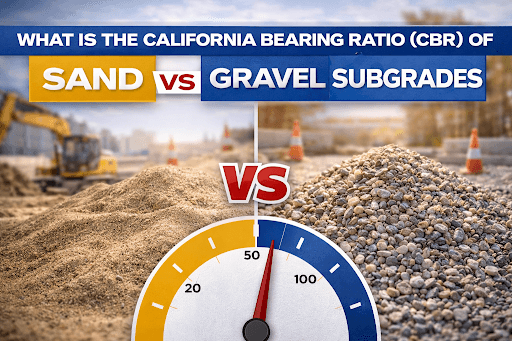
What Does California Bearing Ratio Really Mean?
The California Bearing Ratio shows how strong a soil or base layer performs under pressure. It compares the strength of soil to crushed rock. A higher value means stronger support for roads, driveways, and foundations.
Think of it like this. A higher number means less sinking. A lower number means more movement under weight. That difference decides how long a surface lasts.
Engineers use this value to choose between sand, gravel, or mixed materials. The right material selections help avoid future problems, which include cracks, sinkage, and expensive repair work.
Sand vs Gravel: The Real Difference
Sand and gravel in California both serve as subgrade materials. However, both behave very differently under load.
Sand Subgrades
Sand feels smooth and loose. It drains water fast. That sounds useful at first. However, sand shifts easily when pressure increases. Load spreads unevenly, which lowers strength over time.
Compacted sand can perform well in light applications. Still, heavy loads push sand particles apart. That reduces support quickly.
Typical CBR values for sand stay in a lower range. Fine sand performs even more weakly compared to coarse sand.
Gravel Subgrades
Gravel feels rough and solid. Particles lock together under pressure. This interlocking effect improves strength and load distribution.
Gravel holds shape better under repeated traffic. That makes it ideal for roads and driveways. Larger particles resist movement, which improves durability.
CBR values for gravel stay much higher than sand. Crushed gravel performs even better due to its angular edges.
Why Gravel Usually Wins?
Gravel wins in most structural applications. The reason is simple. Strength and stability matter more than just drainage.
Here's what gravel does better:
- Handles heavy loads with less deformation
- Provides a strong interlocking structure
- Maintains shape under repeated stress
- Offers higher long-term performance
Sand still plays a role. It works well in drainage layers or as a base for light loads. However, gravel remains the safer choice for strength.
How Compaction Changes Everything?
Compaction plays a huge role in performance. Loose material always fails faster.
Well-compacted sand improves its strength. However, it still cannot match gravel under high loads. Gravel compacts into a dense structure that holds weight better.
Moisture also affects compaction. Slight moisture helps particles bind better. Too much water weakens both materials.
Real-World Use Cases
When to Use Sand
- Bedding for pipes and utilities
- Base for pavers in low-load areas
- Drainage layers under structures
When to Use Gravel
- Road base layers
- Driveways and parking lots
- Foundation support layers
- Heavy equipment areas
Field Testing Matters More Than Guesswork
Numbers on paper guide decisions. Field testing confirms real performance.
The California Bearing Ratio test helps measure actual strength. This test simulates pressure conditions similar to real use. It gives a clear value for design decisions.
Testing becomes even more important when soil conditions vary across a site. A small change in soil type can impact results heavily.
Key Factors That Affect CBR Values
Particle Size Distribution:
Well-graded materials perform better. Mixed sizes fill gaps and increase density.
Moisture Content:
Too much water weakens the structure. Balanced moisture improves compaction.
Compaction Level:
Higher compaction increases strength significantly.
Material Type:
Gravel naturally provides higher resistance than sand.
Sand and Gravel Together: A Smart Mix
Mixing sand and gravel in California often improves performance. This combination fills voids and increases density.
Blended materials provide better load support than sand alone. Many construction projects use this mix to balance cost and strength.
However, mix ratios must stay controlled. Too much sand reduces strength. Too much gravel increases cost without added benefit in some cases.
Conclusion
The selection process for sand and gravel depends on three factors which include strength, stability, and project requirements. The California Bearing Ratio demonstrates that gravel delivers superior load capacity for most situations. Sand still works in specific roles like drainage or light loads. The superior option for enduring performance remains gravel as the better choice.
For consistent quality and reliable supply, ContractorLOADS helps ensure every project starts with the right foundation.
FAQs
Q: What is the California Bearing Ratio, and why is it important? The California Bearing Ratio measures soil strength under load conditions. It helps engineers decide suitable materials for construction projects.
Q: How does the California bearing ratio test procedure work? The test checks soil behavior under pressure using a piston that applies load to a compacted sample. Resistance measurements get compared to standard values to predict real-world material performance.
Q: What is the difference between the California Bearing Ratio formula and actual field results? Lab formula values use controlled conditions and fixed preparation methods, while field results vary based on moisture, compaction, and soil variation that rarely match laboratory settings.
Q: Why is the Sacramento sand and gravel supply important for local projects? Local sourcing reduces transport costs, ensures timely delivery, and typically matches regional soil conditions better than distant suppliers.