
May 20, 2026
Angular vs Rounded Gravel: Key Differences Explained
Gravel shape — often overlooked in favor of size and color — is a critical factor determining project success. The distinction between angular and rounded gravel explains performance differences, such as why driveways can deteriorate rapidly after installation.
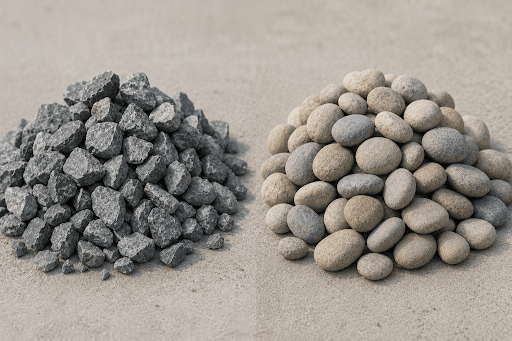
How Gravel Gets Its Shape
Rounded gravel forms through natural water erosion. Rivers and streams tumble rocks over thousands of years, smoothing edges into polished particles resembling marbles.
Angular gravel is produced mechanically. Rock is fed into crushing equipment and broken apart, resulting in jagged, sharp-edged particles with flat faces and irregular shapes.
Why Shape Affects Performance
Rounded particles lack locking capability and sit loosely, allowing movement under pressure. Angular particles create strong aggregate interlock during compaction through their sharp edges and flat faces, offering superior shear strength and compaction efficiency.
Where Each Type Is Used
Angular gravel suits load-bearing applications: driveways, building pad bases, retaining wall backfill, road bases, and structural fill. Rounded gravel works well for decorative paths, garden beds, certain pipe bedding applications, and concrete mixes where workability matters.
Compaction and Long-Term Settlement
Rounded gravel settles over time because particles can roll and reposition. Angular gravel, once compacted, maintains stability through interlocked structure, providing superior long-term settlement resistance.
Conclusion
Shape significantly impacts performance. Angular gravel offers better compaction, settlement resistance, and load stability, while rounded gravel suits decorative or low-demand applications.
FAQs
Which is better for a driveway, angular or rounded? Angular gravel is recommended for driveways due to superior long-term performance. It creates stronger interlock, improves stability, and handles vehicle traffic more effectively than rounded alternatives.
Does particle shape really affect compaction that much? Yes, significantly. Angular particles compact into a stable matrix through their irregular shapes, while rounded particles resist compaction because smooth surfaces slide rather than lock.
Is rounded gravel ever the better option? Yes. Rounded gravel works well for decorative landscaping, certain pipe bedding applications, and concrete mixes where wet material workability is prioritized over structural performance.
How big is the shear strength difference between the two? Significant. Angular gravel resists shear through rough surfaces and friction, while rounded gravel exhibits noticeably lower shear strength, allowing greater movement.
What should I ask the supplier before ordering? Inquire about particle angularity versus roundness, intended application specifications, and whether material is crushed or naturally sourced. Suppliers should help match material to specific project demands.